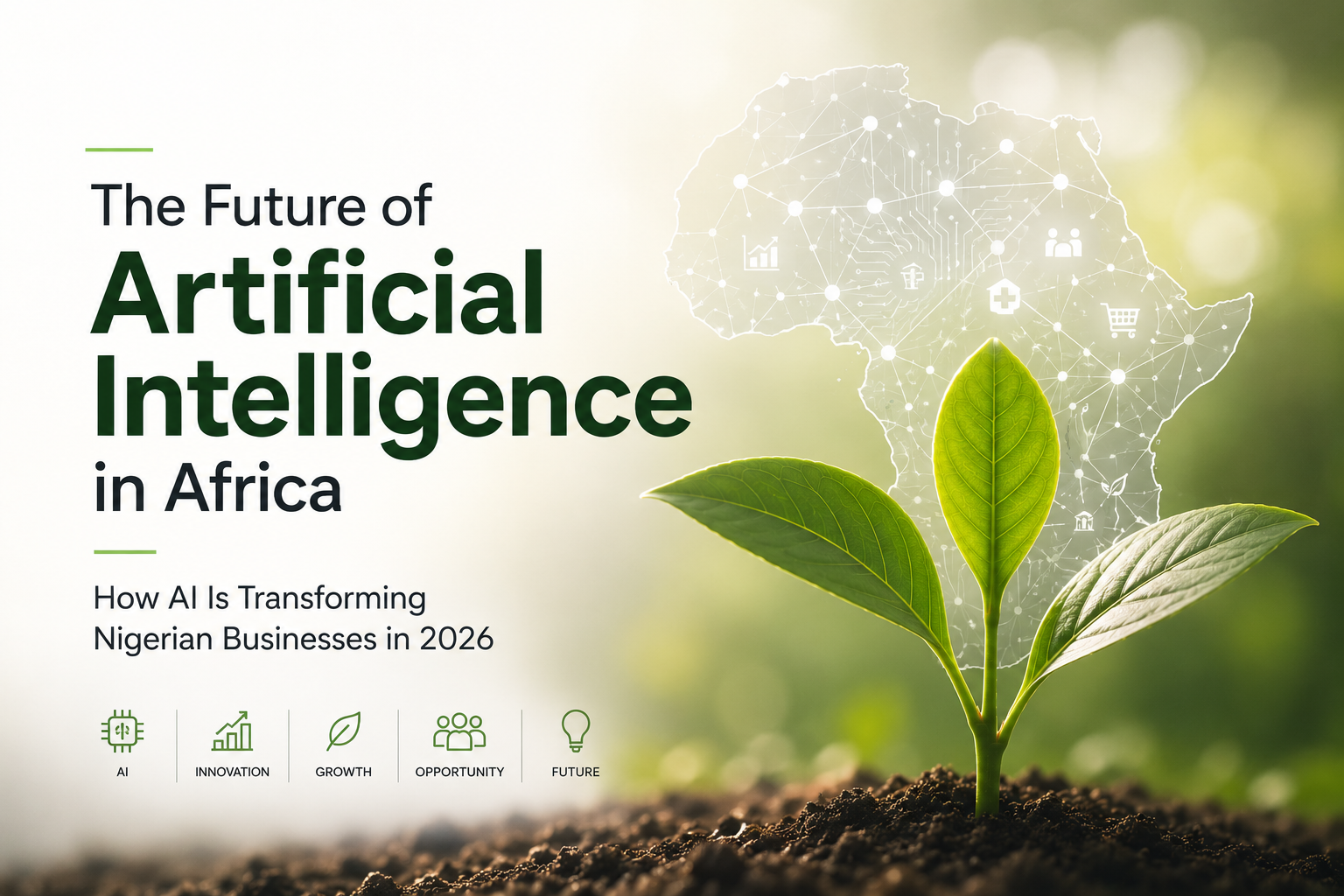
The Future of Artificial Intelligence in Africa: How AI Is Transforming Nigerian Businesses in 2026
Category: Artificial Intelligence
Reading Time: 12 Minutes
Summary
Artificial Intelligence (AI) is rapidly transforming Africa's business landscape, with Nigeria leading innovation across fintech, healthcare, agriculture, education, logistics, media, cybersecurity, and enterprise technology. From automating customer service to improving financial inclusion and enhancing healthcare delivery, AI is helping organizations become more efficient, competitive, and data-driven. This guide explores how artificial intelligence is reshaping African businesses, the opportunities it presents for entrepreneurs, startups, government institutions, and enterprises, and why understanding AI is becoming essential for Africa's digital future.
Quick Facts
| Topic | Information |
|---|---|
| Primary Focus | Artificial Intelligence in Africa |
| Industries Impacted | Banking, Healthcare, Agriculture, Education, Logistics, Government, Retail, Telecommunications |
| Key Technologies | Generative AI, Machine Learning, Natural Language Processing, Computer Vision, Predictive Analytics |
| Target Audience | Business Owners, Entrepreneurs, Executives, Developers, Startups, Investors, Students |
| Region | Nigeria, Africa, African Diaspora |
Table of Contents
- What is Artificial Intelligence?
- Why AI Matters for Africa
- How Nigerian Businesses Are Using AI
- Industries Being Transformed
- Opportunities for African Entrepreneurs
- Challenges of AI Adoption
- The Future of AI in Africa
- Frequently Asked Questions
What Is Artificial Intelligence?
Artificial Intelligence (AI) refers to computer systems designed to perform tasks that traditionally require human intelligence. These include understanding language, recognizing images, making predictions, solving problems, generating content, automating repetitive work, and assisting people in making better decisions.
Unlike traditional software that follows fixed instructions, modern AI systems learn from data, identify patterns, and continuously improve their performance. This capability allows businesses to automate processes, reduce operational costs, improve customer experiences, and make faster, more informed decisions.
Across Africa, artificial intelligence is no longer a futuristic concept. It has become a practical business tool helping organizations overcome long-standing challenges such as limited infrastructure, manual processes, financial exclusion, healthcare accessibility, and educational inequality.
For Nigeria, where innovation continues to drive economic growth, AI represents one of the greatest opportunities for businesses seeking sustainable competitive advantage.
Why Artificial Intelligence Matters for Africa
Africa is experiencing one of the world's fastest rates of digital transformation. Increasing internet penetration, mobile connectivity, cloud computing adoption, digital payments, and a rapidly growing startup ecosystem have created the ideal environment for artificial intelligence to flourish.
Rather than replacing people, AI is increasingly helping organizations improve productivity while allowing professionals to focus on higher-value activities such as strategy, innovation, customer engagement, and business growth.
Several factors make AI particularly important across Africa:
- Growing digital economy.
- Increasing mobile internet adoption.
- Expansion of cloud computing infrastructure.
- Rapid fintech innovation.
- Government digital transformation initiatives.
- Growing technology startup ecosystem.
- Young and digitally connected population.
- Rising demand for automation and productivity.
Countries including Nigeria, Kenya, South Africa, Rwanda, Ghana, and Egypt continue investing heavily in technology ecosystems capable of supporting artificial intelligence innovation. These investments are creating opportunities not only for large enterprises but also for small businesses and entrepreneurs.
MyMediaAfrica Insight: Artificial Intelligence should not be viewed as technology replacing people. Instead, it should be seen as technology empowering Africans to solve uniquely African challenges through smarter decision-making, increased efficiency, and scalable innovation.
How Nigerian Businesses Are Using Artificial Intelligence
Nigeria has emerged as one of Africa's largest technology markets. From Lagos to Abuja, Port Harcourt, Ibadan, Enugu, Kano, and beyond, organizations are increasingly integrating AI into everyday business operations.
Financial institutions use AI-powered fraud detection systems capable of identifying suspicious transactions in real time. Healthcare providers leverage machine learning to support diagnostics and patient management. Educational institutions use AI to personalize learning experiences, while retailers rely on predictive analytics to improve inventory management and customer engagement.
Customer service has also undergone significant transformation. AI-powered virtual assistants now provide instant responses to customer enquiries, reducing waiting times while improving service quality.
For startups, artificial intelligence enables founders to compete with much larger organizations by automating marketing, sales, finance, customer support, and business intelligence without significantly increasing operational costs.
The result is a more competitive, efficient, and innovation-driven business ecosystem that continues to attract local and international investment.
Artificial Intelligence Is Creating New Career Opportunities
One common misconception is that AI will eliminate jobs. In reality, artificial intelligence is changing the nature of work rather than eliminating the need for skilled professionals.
Across Africa, demand continues growing for AI engineers, machine learning specialists, cloud architects, cybersecurity professionals, data analysts, prompt engineers, AI product managers, DevOps engineers, and digital transformation consultants.
Universities, private training institutions, technology academies, and online learning platforms are increasingly introducing AI-focused programmes to prepare Africa's workforce for the future digital economy.
This shift creates tremendous opportunities not only for students but also for professionals seeking career advancement through upskilling and continuous learning.
Industries Being Transformed by Artificial Intelligence Across Africa
Artificial Intelligence is no longer limited to global technology companies. Across Nigeria and Africa, organizations of all sizes are integrating AI into their operations to improve efficiency, reduce costs, enhance customer experiences, and make better decisions. While adoption varies by industry, the impact is becoming increasingly visible across sectors that are critical to Africa's economic growth.
From financial institutions and healthcare providers to agricultural businesses, educational institutions, media organizations, and government agencies, AI is helping solve problems that have existed for decades. Rather than replacing human expertise, these technologies are supporting professionals by automating repetitive tasks, identifying valuable insights from data, and enabling faster decision-making.
Artificial Intelligence in Banking and Financial Services
Nigeria's fintech ecosystem has become one of Africa's most successful innovation stories, and Artificial Intelligence is playing an increasingly important role in that success.
Financial institutions now use AI to detect fraudulent transactions in real time, evaluate credit risks, personalize customer experiences, automate compliance processes, and provide intelligent financial recommendations.
Instead of reviewing thousands of transactions manually, AI-powered systems can instantly identify unusual spending patterns, reducing fraud while improving customer trust.
Many digital banks are also integrating conversational AI to provide customers with faster support, account information, payment assistance, and financial education.
As digital payments continue to grow across Africa, AI will become even more important in protecting financial systems and improving financial inclusion.
- Fraud detection
- Credit scoring
- Customer support automation
- Risk management
- Regulatory compliance
- Financial forecasting
Artificial Intelligence in Healthcare
Healthcare remains one of Africa's greatest opportunities for AI-driven innovation.
Many communities still experience shortages of healthcare professionals, delayed diagnoses, and limited access to specialist care. Artificial Intelligence is helping bridge some of these gaps by assisting healthcare providers with diagnostics, medical imaging analysis, patient monitoring, appointment scheduling, and predictive healthcare planning.
Hospitals are increasingly adopting AI-powered systems that analyze patient data, helping doctors make more informed decisions while reducing administrative workloads.
Telemedicine platforms also use AI to improve patient engagement, automate triage, and provide faster access to medical information, particularly in underserved communities.
MyMediaAfrica Insight: AI will not replace doctors. Instead, it will help healthcare professionals make faster, more accurate decisions while expanding access to quality healthcare across Africa.
Artificial Intelligence in Agriculture
Agriculture remains one of Africa's largest economic sectors, supporting millions of livelihoods across the continent.
Artificial Intelligence is helping farmers improve productivity by analyzing weather patterns, predicting crop diseases, monitoring soil conditions, optimizing irrigation, and forecasting market demand.
Using satellite imagery, drones, and machine learning, farmers can identify potential issues before they become major problems, helping reduce waste while improving food security.
For African agribusinesses, AI represents an opportunity to increase productivity while supporting sustainable farming practices.
- Crop monitoring
- Weather prediction
- Yield forecasting
- Precision agriculture
- Supply chain optimization
Artificial Intelligence in Education
Education is another sector undergoing significant transformation through Artificial Intelligence.
Educational institutions increasingly use AI-powered learning platforms to personalize lessons, identify learning gaps, automate assessments, and improve student engagement.
Students can now receive personalized recommendations based on their learning styles while teachers gain valuable insights into classroom performance.
Across Nigeria and the African diaspora, AI also enables professionals to access online learning opportunities that support continuous career development in cloud computing, cybersecurity, software engineering, digital marketing, data science, and enterprise technology.
Artificial Intelligence in Logistics and Transportation
Efficient logistics remains essential to Africa's growing economy.
Artificial Intelligence helps logistics companies optimize delivery routes, predict maintenance requirements, reduce fuel consumption, improve warehouse management, and enhance supply chain visibility.
With rapid growth in e-commerce and digital commerce, businesses increasingly depend on AI-powered forecasting to anticipate customer demand while improving inventory planning.
For logistics providers operating across multiple African countries, AI offers valuable insights that support faster deliveries and more efficient operations.
Artificial Intelligence in Government and Public Services
Governments across Africa are exploring Artificial Intelligence to improve public service delivery.
Potential applications include:
- Digital identity management
- Tax administration
- Healthcare planning
- Education management
- Traffic monitoring
- Urban planning
- Citizen engagement
- Public safety
When implemented responsibly, AI can improve transparency, reduce administrative bottlenecks, and strengthen public sector efficiency.
Artificial Intelligence in Media and Communications
The media industry is evolving rapidly as Artificial Intelligence changes how content is created, distributed, and consumed.
Publishers now use AI to analyze audience behavior, recommend relevant content, automate transcription, improve search optimization, generate multilingual summaries, and enhance digital storytelling.
However, AI should support journalism rather than replace it. Human expertise remains essential for investigative reporting, editorial judgment, ethical decision-making, and accurate storytelling.
For platforms like MyMediaAfrica, Artificial Intelligence presents an opportunity to deliver richer experiences while maintaining editorial integrity and trusted reporting.
Why African Entrepreneurs Should Embrace Artificial Intelligence
Artificial Intelligence is no longer reserved for multinational corporations. Cloud-based AI platforms, open-source tools, and software-as-a-service solutions have made advanced technologies accessible to startups and small businesses across Africa.
Entrepreneurs can use AI to automate customer service, improve digital marketing, generate business insights, analyze customer feedback, optimize operations, and create personalized user experiences without building complex systems from scratch.
Businesses that adopt AI strategically are likely to gain competitive advantages through increased efficiency, better customer engagement, and faster decision-making.
| Business Function | How AI Creates Value |
|---|---|
| Marketing | Content creation, audience analysis, campaign optimization |
| Sales | Lead scoring, customer insights, sales forecasting |
| Customer Service | Virtual assistants, automated responses, knowledge management |
| Operations | Workflow automation, reporting, process optimization |
| Finance | Fraud detection, forecasting, expense analysis |
| Human Resources | Recruitment support, employee analytics, training recommendations |
The organizations that will benefit most from Artificial Intelligence are not necessarily those with the largest budgets, but those willing to invest in learning, experimentation, responsible implementation, and continuous innovation.
Challenges Slowing AI Adoption Across Africa
While Artificial Intelligence presents enormous opportunities for Africa, widespread adoption is not without its challenges. Businesses, governments, educational institutions, and technology providers must work together to overcome these barriers if Africa is to fully participate in the global AI economy.
Many organizations are eager to adopt AI but face obstacles related to infrastructure, digital skills, funding, regulation, and access to reliable data. Addressing these issues requires long-term investment, collaboration, and responsible innovation.
Limited Digital Infrastructure
Reliable internet connectivity, cloud infrastructure, and stable electricity remain essential for AI adoption. Although significant progress has been made across Africa, many communities and businesses still experience infrastructure limitations that affect the deployment of AI-powered solutions.
Continued investment in broadband connectivity, cloud services, and digital infrastructure will play a critical role in accelerating AI innovation across the continent.
Skills Gap and Talent Development
Artificial Intelligence requires professionals with expertise in machine learning, cloud computing, cybersecurity, software engineering, data science, and digital transformation.
Africa's technology talent pool continues to grow rapidly, but demand for skilled professionals still exceeds supply. Universities, technology academies, governments, and private organizations must continue investing in digital education to prepare the next generation of innovators.
The encouraging news is that many young Africans are already embracing careers in AI, software development, cloud engineering, cybersecurity, and data analytics, positioning the continent for long-term growth.
Access to Quality Data
AI systems perform best when trained using accurate, relevant, and diverse datasets. Many African organizations still face challenges in collecting, organizing, and maintaining quality business data.
As organizations continue their digital transformation journeys, better data governance and improved data management practices will become increasingly important for successful AI implementation.
Ethics, Privacy, and Responsible AI
Artificial Intelligence should always be developed and deployed responsibly. Organizations must ensure that AI systems are transparent, fair, secure, and respectful of individual privacy.
Responsible AI includes:
- Protecting customer data.
- Reducing algorithmic bias.
- Maintaining transparency in automated decisions.
- Ensuring human oversight.
- Following regulatory requirements.
- Building trustworthy AI systems.
As AI adoption grows across Africa, ethical governance will become just as important as technological innovation.
The African Diaspora and the AI Economy
The African diaspora represents one of the continent's greatest strategic advantages. Across North America, Europe, the Middle East, and other regions, African professionals continue leading innovation in cloud computing, cybersecurity, artificial intelligence, healthcare technology, finance, research, and enterprise software.
These professionals possess valuable experience, global networks, and technical expertise that can accelerate Africa's digital transformation.
Increasing collaboration between local innovators and the diaspora will help strengthen investment, knowledge sharing, mentorship, research, and technology transfer across the continent.
Artificial Intelligence creates new opportunities for remote collaboration, global entrepreneurship, cross-border innovation, and digital trade, allowing African professionals worldwide to contribute meaningfully to the continent's future.
The Future of Artificial Intelligence in Africa
Artificial Intelligence is expected to become one of the most influential technologies shaping Africa's economic future over the next decade.
As cloud computing becomes more accessible and organizations continue investing in digital transformation, AI adoption is expected to accelerate across virtually every sector of the economy.
Emerging technologies such as Generative AI, Agentic AI, predictive analytics, robotics, intelligent automation, and autonomous decision support systems will increasingly become part of everyday business operations.
For Africa, the opportunity extends beyond adopting existing technologies. The continent has the potential to build AI solutions specifically designed to address African challenges in healthcare, agriculture, education, financial inclusion, governance, climate resilience, and entrepreneurship.
Businesses that begin preparing today by investing in digital skills, cloud infrastructure, cybersecurity, and responsible AI governance will be better positioned to compete in tomorrow's digital economy.
MyMediaAfrica Perspective: Africa's future will not be defined simply by consuming technology developed elsewhere. It will be shaped by African innovators, entrepreneurs, researchers, and technology leaders building intelligent solutions that solve local challenges while competing on a global stage.
Key Takeaways
- Artificial Intelligence is becoming a major driver of Africa's digital economy.
- Nigeria remains one of Africa's fastest-growing AI innovation hubs.
- AI is transforming banking, healthcare, education, agriculture, logistics, media, manufacturing, and government.
- Responsible AI requires strong governance, cybersecurity, ethical standards, and human oversight.
- Cloud computing provides the foundation for scalable AI adoption.
- The African diaspora will continue playing an important role in technology transfer and innovation.
- Businesses that embrace AI strategically will improve productivity, competitiveness, and long-term sustainability.
- Continuous learning and digital skills development are essential for future success.
Frequently Asked Questions (FAQs)
What is Artificial Intelligence?
Artificial Intelligence (AI) refers to computer systems capable of performing tasks that normally require human intelligence, including learning, problem-solving, language understanding, and decision-making.
Why is AI important for Africa?
AI helps organizations improve efficiency, expand access to services, support innovation, and solve challenges across healthcare, agriculture, education, finance, and government.
How are Nigerian businesses using AI?
Businesses use AI for customer service, fraud detection, predictive analytics, marketing automation, cybersecurity, business intelligence, and workflow automation.
Will AI replace jobs?
AI will automate certain repetitive tasks, but it is also creating demand for new skills and careers in cloud computing, machine learning, cybersecurity, software engineering, data science, and AI governance.
Which industries benefit most from AI?
Banking, healthcare, education, agriculture, logistics, retail, telecommunications, media, manufacturing, and government are among the sectors experiencing significant AI-driven transformation.
What skills should professionals learn?
Cloud computing, data analytics, cybersecurity, software development, prompt engineering, AI governance, and machine learning are increasingly valuable skills in today's digital economy.
Can small businesses use AI?
Yes. Many affordable AI-powered tools are available to help SMEs improve productivity, automate customer support, generate content, analyze data, and streamline business operations.
How does cloud computing support AI?
Cloud platforms provide the computing power, storage, scalability, and AI services needed to build and deploy intelligent applications without investing in expensive hardware.
What is Generative AI?
Generative AI refers to systems capable of creating new content such as text, images, videos, code, and business insights based on user prompts and training data.
What role will AI play in Africa's future?
AI is expected to accelerate innovation, improve productivity, strengthen public services, support entrepreneurship, and contribute significantly to Africa's long-term economic development.
Conclusion
Artificial Intelligence is no longer a technology of the future—it is already transforming how African businesses operate, compete, and innovate. From startups developing AI-powered products to enterprises modernizing their operations through intelligent automation, the continent is entering a new era of digital growth.
For Nigeria and the broader African ecosystem, the greatest opportunity lies not only in adopting AI but also in creating solutions that address uniquely African challenges while contributing to the global technology landscape.
The organizations that succeed in this new era will be those that combine innovation with responsible governance, continuous learning, and a clear focus on delivering measurable business value.
About MyMediaAfrica
MyMediaAfrica is a leading digital media platform dedicated to covering Africa's technology ecosystem, innovation, digital transformation, business leadership, artificial intelligence, cloud computing, cybersecurity, startups, and emerging technologies. Through in-depth analysis, executive profiles, industry insights, and thought leadership, MyMediaAfrica connects readers across Africa and the diaspora with the ideas, people, and innovations shaping the continent's digital future.
Related Topics You May Find Helpful
If you found this guide valuable, you may also be interested in exploring other technology and business insights from MyMediaAfrica.
- Cloud Computing in Africa: Opportunities for Modern Businesses
- Digital Transformation Strategies for African Enterprises
- The Rise of FinTech Innovation Across Africa
- Cybersecurity Best Practices for Nigerian Businesses
- How Artificial Intelligence Is Changing Healthcare in Africa
- The Future of Cloud Computing in Nigeria
- Top African Technology Leaders Driving Digital Innovation
- How Startups Are Leveraging AI to Scale Across Africa
Key Statistics at a Glance
| Area | AI Impact |
|---|---|
| Banking | Fraud detection, customer service, credit analysis |
| Healthcare | Medical diagnostics, patient monitoring, telemedicine |
| Education | Personalized learning, assessment, tutoring |
| Agriculture | Crop monitoring, weather prediction, yield optimization |
| Government | Digital services, smart governance, planning |
| Retail | Recommendation engines, customer analytics |
| Logistics | Route optimization, inventory forecasting |
| Manufacturing | Predictive maintenance, quality control |
Final Thoughts
Africa stands at one of the most exciting moments in its digital history. Artificial Intelligence is no longer a concept reserved for global technology companies—it is becoming an essential business capability for organizations across Nigeria and the continent.
Businesses that invest in digital skills, cloud infrastructure, cybersecurity, and responsible AI today will be better prepared for tomorrow's economy. More importantly, Africa has the opportunity not only to adopt Artificial Intelligence but also to build innovative AI-powered solutions that solve local challenges while creating global impact.
At MyMediaAfrica, we remain committed to documenting this transformation by highlighting the people, organizations, innovations, and technologies shaping Africa's digital future.
Published by MyMediaAfrica
Covering Technology • Artificial Intelligence • Cloud Computing • Cybersecurity • Startups • Business Innovation • Digital Transformation across Africa.